|
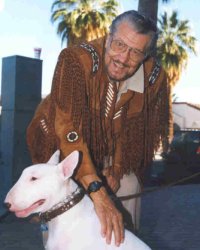
Herb Jeffries
was, in the tradition of Gene Autry and Roy
Rogers, a Hollywood created, silver screen,
singing cowboy hero.
He starred in five films in the late 1930's, but
Jeffries was a different type of cowpoke. He was "The
Bronze Buckaroo."
"In those days, my driving force was being
a hero to children who didn't have any heroes to identify with,"
Jeffries says. "I felt that dark-skinned children could
identify with me and, in "The Bronze Buckaroo,"
they could have a hero. Many people don't realize (to this
very day) that in the Old West, one out of every three cowboys
was a Black... and there were many Mexican cowboys, too."
From the time Jeffries was a child he was a cowboy
at heart. He learned to ride horses on his grandfather's
dairy farm in northern Michigan and he spent many afternoons in
Detroit movie houses watching screen cowboys Buck Jones and Tom
Mix.
But Herb Jeffries, like millions of other children
of color, never saw any cowboys that looked like him.
Jeffries made it his personal mission to change
that after he saw a Jed Buell film called "The Terror in
Tiny Town," made with a cast of little people.
"I thought if Buell would produce a movie
with "Little People," then maybe he would make an all-Black
picture," Jeffries said.
Jeffries trekked to Buell's Gower Gulch office
and persuaded him to make just such a motion picture, which was
distributed, by a Dallas company, to mostly segregated black theaters
in the South. With the success of that first film ("Harlem
On The Prairie"), several more were soon to follow.
Professor Jules-Rosette, of The University of California
at San Diego, says that these films had much deeper implications:
"These films were the first to show blacks as heroes and
not servants, they allowed blacks to be themselves in a public
outlet. They could be multidimensional people in the movies,
while they lived in an outside world where they had to be subservient."
About a decade after Jeffries retired from the
screen and the sun then set on the era of Black cowboy films.
During his movie-making days in the late 30's, Jeffries
met his personal screen hero, Mr. Gene Autry, at a cowboy festival
in California. "He walked over to me and told me he
liked my pictures," Jeffries says. "I was thrilled beyond
words to have heard him say that."
In 1939, Jeffries hung up his spurs to sing and
tour with Duke Ellington's Orchestra. He later served in WWII
and then went on to live for a decade in France, where he ran
a Jazz supper club. His nightly list of patrons included
the likes of Orson Welles, Ali Khan and King Farouk of Egypt.
When Herb Jeffries walked into the RCA Victor
Studio in Chicago on December 28th, 1940 for a Duke Ellington
recording session, he had no idea that his future was predestined.
Ellington had called him in at the last minute to record one song,
a tune called "Flamingo" (written by Ted Grouya &
Edmund Anderson). Herb had never sang or even heard the
song before, yet he felt such a personal relationship with the
lyrics and melody that he recorded it in one take.
"Flamingo" did not impress Leonard Joy,
the RCA Victor executive at the time. However, the recording
was finally released in June, 1941, and became an immediate radio
and juke box hit! Herb had, by then, left the Ellington
band and gone off to do his bit for Uncle Sam in WWII. But
the song catapulted Herb into the highest echelon of popular singers.
His three subsequent recordings of "Flamingo" have sold
over 14-million copies... and still counting.
"The Duke and I", Herb's most recent
CD album, constitutes a reunion of Herb Jeffries and the timeless music of the
great Duke Ellington on the 100th birthday year of the world famous composer and
band leader.
|